The complete guide
Buying property in Lombok as a foreigner.
Freehold, leasehold, Hak Pakai and PT PMA, explained in plain English. The definitive, no-jargon guide to what you can legally own on the south coast, and how to do it safely.
On this page
Can foreigners own land?The four ownership routesCompare structuresThe buying processCosts & feesCommon questionsCan a foreigner own land in Lombok? Not freehold, directly, no. But foreigners legally buy and hold South Lombok property every day through three well-established routes: a long leasehold (Hak Sewa), a Hak Pakai right-to-use title, or a PT PMA company that holds HGB title. The right choice depends on whether you are buying a home, an investment, or both.
This guide is education, not legal advice. Always confirm your specific structure with a licensed Indonesian notary before committing funds.
Can foreigners own land in Lombok?
Indonesian law reserves freehold title (SHM, Hak Milik) for Indonesian nationals. A foreigner cannot hold SHM in their own name. This single fact is the source of most fear in the market, and most of the bad advice. The good news: there are legal, transparent alternatives that give you secure, enforceable rights, without the discredited nominee arrangements that put your money at risk.
The four ownership routes
Freehold (SHM). The strongest title, full ownership. Available to Indonesian citizens only. Relevant to you mainly as the title your leasehold or company sits beneath.
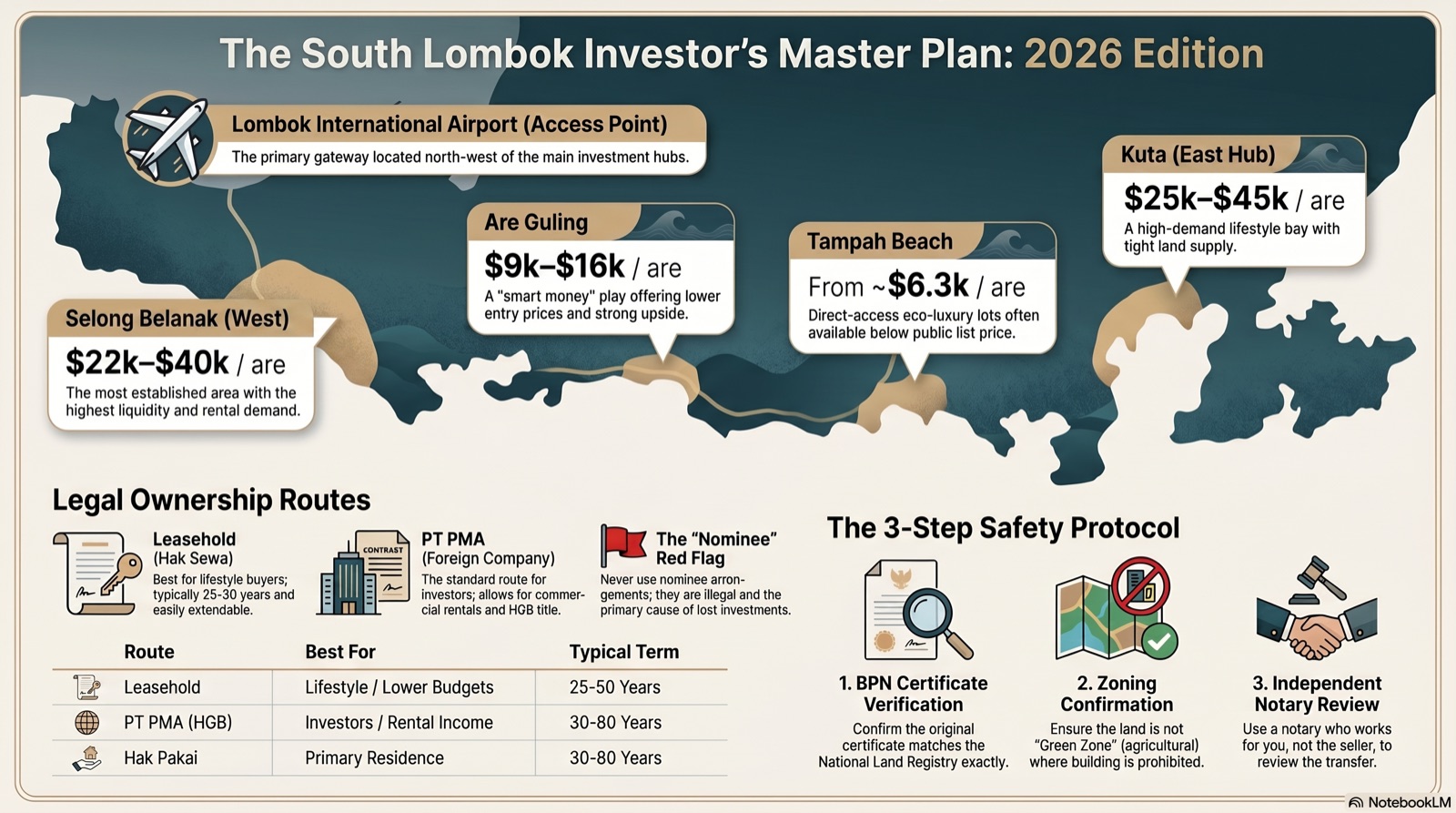
Leasehold (Hak Sewa). You lease the land or villa for a fixed term, commonly 25 to 30 years, often with agreed extension rights. Simple, lower upfront cost, and the most common route for lifestyle buyers. Your protection lives in a properly drafted, notarised agreement.
Hak Pakai (right to use). A use-title a foreigner with the right permit can hold over a residence, for renewable terms. A good fit for a primary home you intend to live in.
PT PMA (foreign-owned company). You set up an Indonesian company that you own, which can hold HGB (right-to-build) title. This is the standard route for investment villas and rental businesses, because it allows legal commercial use. Setup is a known, packaged process with ongoing compliance.
Compare the structures at a glance
| Route | Who it suits | Typical term | Can rent commercially? |
|---|---|---|---|
| Leasehold (Hak Sewa) | Lifestyle buyers, lower budget | 25-30 yrs, extendable | Limited |
| Hak Pakai | A primary residence | Renewable use-title | No |
| PT PMA (HGB) | Investors, rental income | 30 yrs, extendable | Yes |
| Freehold (SHM) | Indonesian nationals | Permanent | Yes |
Terms are indicative and change with regulation. Your notary confirms the current specifics for your situation.
The buying process, step by step
Our process is deliberately calm. Most buyers research for 6 to 18 months, and that is completely normal for a decision this size.
- Orientation. A free 30-minute call to understand your goal, budget and timeline.
- Shortlist. Three verified options that genuinely fit, each already title-checked.
- Due diligence. Your independent notary verifies the BPN certificate, zoning, access and a clean transfer.
- Structure. We set up the correct route, leasehold agreement, Hak Pakai, or PT PMA, with vetted partners.
- Transfer. Funds move through a notary, title is registered, and you receive your documentation.
Costs and fees to expect
Beyond the purchase price, budget for notary and due-diligence fees, transfer taxes, and, if relevant, PT PMA setup (often quoted from IDR 20 million upwards) and construction (IDR 10 to 22 million per square metre). For buyers, our guidance is free, we are paid through the transaction and are transparent about any partner referrals.
Common questions
Start with a conversation, not a contract
Still have questions about what you can own?
Ask the Compass Concierge any time, or book a free call and we’ll walk you through the right structure for your goal.